

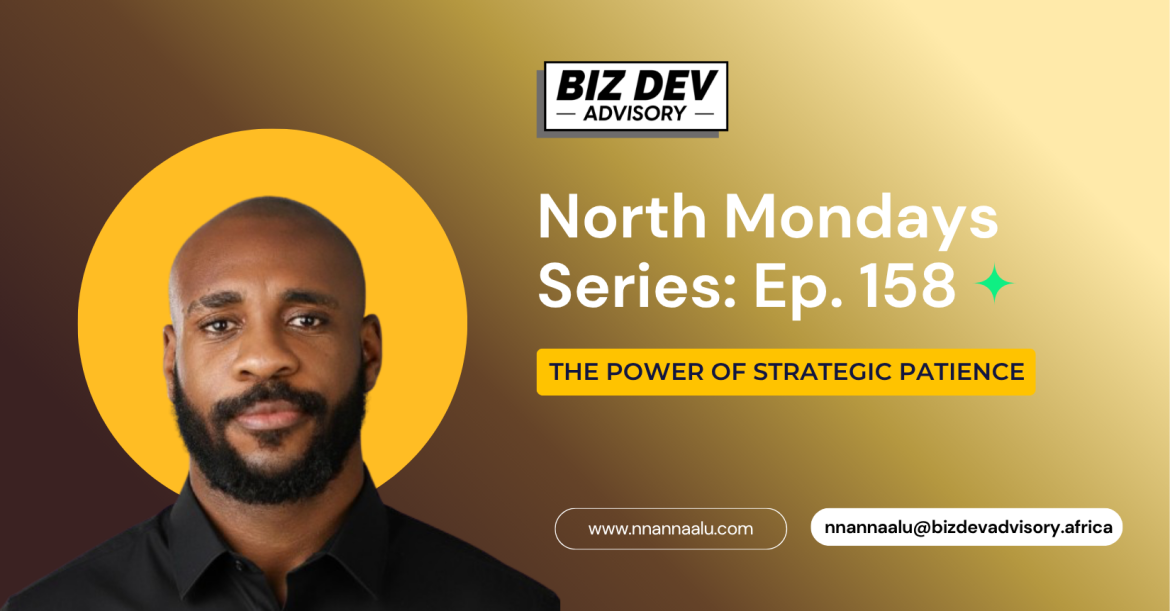
The Power of Strategic Patience

North Mondays Series, Episode 158
Everyone talks about hustle. About moving fast, striking while the iron is hot, seizing opportunities the moment they appear. But very few people talk about strategic patience, the disciplined, intentional decision to hold your position, wait for the right moment, and resist the pressure to act before the time is right.
And yet, strategic patience may be the most powerful business skill you are not developing.
Some of the best decisions in business are not the ones made quickly. They are the ones made at the right time. Strategic patience is not passivity. It is not hesitation, fear, or indecision dressed up in noble language. It is an active, conscious choice to observe, prepare, and wait, because you understand that timing is a competitive weapon.
In this episode of the North Mondays Series, we explore why the ability to pause with purpose is a skill that separates great businesses from reactive ones.
Why Strategic Patience Is a Business Skill, Not a Personality Trait
There is a common misconception that patience is something you either have or you do not. That some people are naturally calm and measured, while others are wired for speed.
Strategic patience is different. It is learned. It is practiced. And it requires as much discipline as any other high-performance skill.
In business, the pressure to act is constant. Investors want results. Competitors appear to be moving. Opportunities seem to be expiring. Team members want direction. Clients want answers. In the middle of all that noise, choosing to pause feels almost irresponsible.
But here is the reality: reactive decisions, made under pressure, without full information, driven by urgency rather than strategy, are among the most expensive mistakes businesses make.
Strategic patience is the antidote. It requires you to:
- Separate urgency from importance
- Distinguish noise from signal
- Resist social and market pressure to act prematurely
- Maintain a long-term view when short-term temptations arise
- Stay prepared so that when the right moment arrives, you can move decisively
Reflection Question: In your last major business decision, were you moving at the right time, or simply responding to pressure?
Strategic Patience in Business: What It Actually Looks Like
Strategic patience is not a single action. It shows up differently depending on where you are in your business journey.
Here are some of the most common, and most important, situations where it applies:
1. Waiting for the Right Market Conditions
Markets shift. Industries go through cycles. A product or service that faces resistance today may find a ready audience in eighteen months.
Strategic patience means resisting the urge to force a product into a market that is not yet ready for it. It means watching trends, preparing your offering, and positioning yourself so that when the market opens up, you are already inside the door.
Understanding how to read those signals is itself a discipline. In Reading the Market Before It Moves, we explored how market trend analysis helps you anticipate shifts rather than simply react to them. Patience becomes far more powerful when it is informed by that kind of foresight.
It also helps to know what your competitors know. Competitive Intelligence gives you the visibility to hold your position without feeling blind. You are not waiting in the dark. You are watching with clarity.
Businesses that rush to launch often spend enormous resources educating a market that is not ready to buy. Businesses with strategic patience time their entry and spend those same resources converting customers who are already looking for what they offer.
2. Holding Off on a Partnership or Deal
Not every deal that appears on your table is a deal worth taking. In business development, the pressure to close, to show activity, to demonstrate traction, can lead you to say yes to the wrong partners, the wrong terms, or the wrong timing.
Strategic patience in deal-making means being willing to walk away from a 70% deal in expectation of a 100% deal. It means holding your position in a negotiation without blinking first. It means understanding that the best partnerships are usually not the fastest ones.
We covered this in depth in Partnerships That Scale Growth. The right partnership model is not just about who is available. It is about who is aligned. And alignment takes time to verify.
3. Allowing a Strategy Time to Work
One of the most damaging business habits is abandoning a strategy too early. You launch a marketing campaign, run it for three weeks, see limited results, and pivot. You hire a business development lead, give them ninety days, and start questioning whether the role is worth it.
Strategic patience understands that most meaningful business strategies take time to compound. Relationships take months to build. Brand awareness takes quarters to shift. Revenue from new client segments often lags the effort that produced it by six to twelve months.
This is closely tied to how you build systems that support long-term thinking. Building Systems That Encourage Innovation makes the case that innovation, like strategy, needs structural support to survive the short-term pressure to show results.
Pulling the plug too early does not just waste the investment you have already made. It also prevents you from ever knowing whether the strategy would have worked.
4. Sitting Out a Trend That Does Not Fit
When an industry trend gains momentum, the pressure to follow is enormous. Competitors are pivoting. Clients are asking questions. The media is buzzing. And there you are, wondering whether you should be doing the same.
This is where Seeing Around Corners: Business Foresight becomes essential. Foresight is not about jumping on every trend. It is about distinguishing the trends that are structurally significant from those that are merely loud.
Strategic patience gives you the confidence to say: this trend is real, but it is not right for us right now. It allows you to watch, learn, and decide on your own terms, rather than chasing every shiny object that appears on the horizon.
Not every trend is worth following. And not every trend that is worth following is worth following immediately.
Strategic Patience vs. Procrastination: Knowing the Difference
This is the critical distinction. Because if strategic patience becomes an excuse for avoidance, it stops being a skill and becomes a liability.
Here is how to tell the difference:
Strategic Patience is active.
You are watching, gathering information, preparing, and waiting for a specific condition to be met. You know what you are waiting for. You have a trigger point that will tell you when to move.
Procrastination is passive.
You are delaying because of fear, uncertainty, or discomfort. There is no clear condition you are waiting to be met. You are simply not moving.
The test is simple: ask yourself, what specific thing am I waiting for? If you have a clear, honest answer, you are practising strategic patience. If the answer is vague or uncomfortable to examine, it may be procrastination.
Strategic patience requires that you stay engaged even while you wait. You are not sitting still. You are preparing, building capability, strengthening relationships, and sharpening your offer, so that when the moment arrives, you can move with precision.
The Business Cost of Moving Too Soon
Impatience has a price. And in business, it is usually higher than people realise.
Here are some of the most common, and costly, consequences of moving before the time is right:
- Launching a product before it is ready, and losing the trust of early adopters
- Hiring ahead of revenue, and creating a cost structure the business cannot sustain
- Signing a deal under pressure, and spending years managing a misaligned partnership
- Scaling before the model is proven, and compounding an unresolved problem
- Making a major investment at the wrong point in the market cycle
Each of these mistakes shares a common root: the decision to move was driven by urgency, not readiness. Strategic patience exists precisely to prevent these outcomes.
The irony is that the businesses trying to move fastest often end up taking the longest to recover from the mistakes that speed produced.
How to Develop Strategic Patience as a Business Practice
Strategic patience does not come naturally in high-pressure environments. It has to be cultivated deliberately. Here is a practical framework for building it into how you and your team operate.
1. Define Your Decision Criteria in Advance
Before you face a pressure situation, decide what conditions must be in place before you act. Write them down. When the pressure comes, and it will, you have a filter that removes emotion from the equation. This is the foundation of good execution. We explored how to turn strategy into structured movement in From Plans to Pathways: Execution Frameworks, and the same principle applies here: clarity before commitment.
If a partnership requires three things from you: alignment on values, clarity on commercial terms, and a proven track record from the other party, then you know exactly what you are waiting for.
2. Create Space Between Stimulus and Response
The best leaders in business have a habit of pausing before they respond. They do not answer in the meeting. They do not reply to the email immediately. They create deliberate distance between the pressure they feel and the decision they make.
That space is where strategic patience lives.
3. Invest in Preparation During the Waiting Period
Strategic patience is only valuable if you use the waiting time well. When you are not yet ready to move on an opportunity, use that time to get ready.
Strengthen your team. Refine your offer. Crafting a Unique Value Proposition is one of the most productive things you can do while you wait. A sharper value proposition means that when you do move, you move with a message the market is ready to receive.
Build the relationships that will matter when you act. The Art of Being Remembered: Relationship Positioningexplains why how you show up during the quiet seasons determines how much leverage you have when the active ones arrive.
Patience without preparation is just delay. Patience with preparation is positioning.
4. Track the Signals That Tell You When to Move
Define your trigger points. What specific market signal, relationship development, or internal capability milestone will indicate that now is the right time?
This keeps you active and alert during the waiting period, and prevents you from waiting forever. Strategic patience has an end point. Know what it is.
5. Protect the Culture Around Decision-Making
If your team rewards speed above all else, strategic patience will be seen as weakness. Shift the conversation.
Celebrate well-timed decisions. Discuss the cost of decisions made too early. Build an environment where the question is not just ‘are we moving?’ but ‘are we moving at the right time?’ The FARMERS Framework is a useful lens here: enterprise growth that lasts is built on deliberate, well-sequenced decisions, not reactive ones.
Common Mistakes That Kill Strategic Patience
- Confusing activity with progress, moving just to look busy
- Letting competitor behaviour set your timeline
- Allowing internal pressure to override external reality
- Failing to distinguish what is urgent from what is important
- Treating patience as permanent when it should be temporary
- Not having a clear definition of what you are waiting for
Strategic patience breaks down when it loses its structure. The moment it becomes vague and indefinite, it stops being a strategy and starts becoming avoidance.
Key Takeaways
- Strategic patience is an active, intentional skill, not passivity or hesitation
- Knowing when not to move is as important as knowing when to move
- Reactive decisions made under pressure are among the most expensive mistakes in business
- Preparation during the waiting period is what separates patience from procrastination
- The best businesses are not just fast, they are well-timed
North Mondays Action Plan
- Identify one area of your business where you are moving under pressure, not strategy
- Write down the specific conditions that would justify moving in that area
- Define what you will do during the waiting period to prepare
- Create a simple decision log: record what you waited for, and what happened as a result. Use the Effective Review of Your Business Year framework to do this consistently at each quarter.
- Build your visibility during the waiting period. Thought Leadership Development shows you how to use quiet seasons to deepen your authority and expand your reach.
- Have a team conversation about the cost of your last reactive decision
Reflection Prompt: Where in your business right now would strategic patience produce a better outcome than immediate action?
Final Note
Speed is seductive. It looks like progress. It feels like confidence. It attracts attention.
But in business, the leaders and organisations that endure are rarely the ones who moved fastest. They are the ones who moved at the right time.
Strategic patience is the discipline of knowing the difference.
It is watching without withdrawing. Waiting without wasting. Holding your position without losing your momentum.
Because in the end, the most powerful move you can make is sometimes the one you choose not to make, until the moment is exactly right.
— Nnanna Alu




Recent Comments