

Building a Personal Brand That Opens Doors

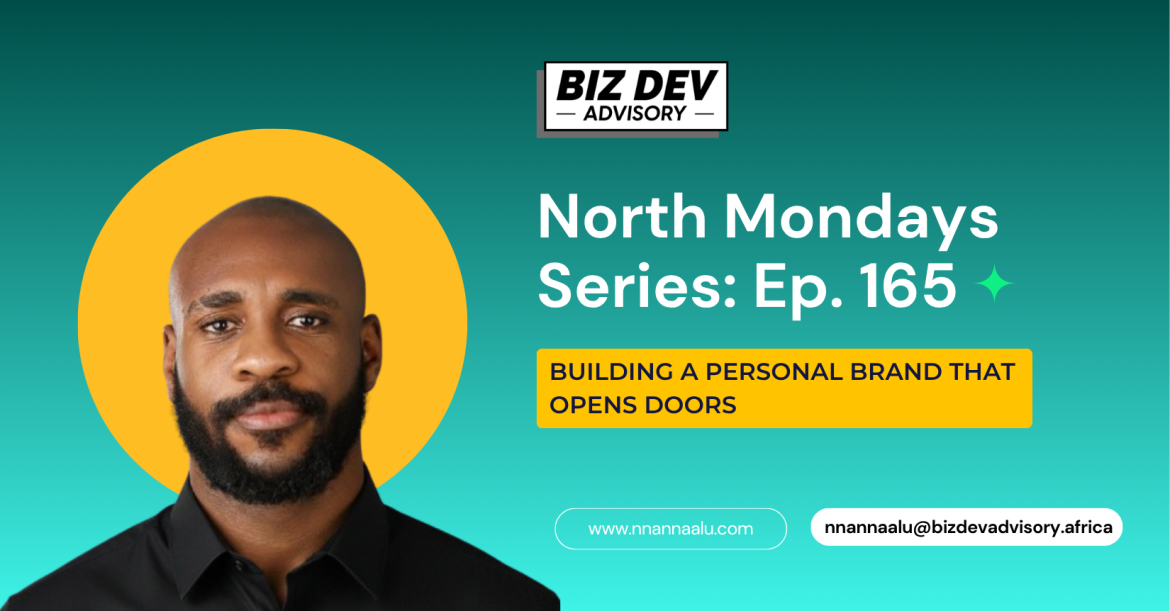
North Mondays Series, Episode 165
Your personal brand already exists. You did not choose whether to have one. You only chose, consciously or by default, what it currently says about you.
Every room you walk into, every email you send, every conversation you have, every piece of content you share or decline to share, every commitment you keep and every one you do not, these are all inputs into a perception that other people carry of you. That perception is your personal brand. And whether it is working for you or against you depends almost entirely on how deliberately you have shaped it.
Building a personal brand that opens doors is not about self-promotion. It is not about performing a version of yourself that impresses people or posting content because the algorithm rewards it. It is about making a clear, honest, consistent statement about who you are, what you stand for, and what value you bring, and then building the visibility and credibility to make that statement land in the rooms and relationships that matter most.
In this episode of the North Mondays Series, we examine what a powerful personal brand is built on, how to construct it with intention, and how to make it work as a door-opening asset in your professional life.
What a Personal Brand That Opens Doors Actually Is
There is a version of personal branding that most people find uncomfortable, and rightly so. It is the version that is mostly performance: the carefully curated LinkedIn feed, the manufactured insight, the relentless self-citation, the professional who seems to have an opinion on everything and a genuine understanding of very little.
That is not what we are talking about here. A personal brand that opens doors is something fundamentally different. It is a reputation so clear, so consistent, and so genuinely useful to the people who encounter it that it creates opportunity without you having to chase it.
It is built on three things. The first is substance: you actually know something, do something, or have achieved something that is worth paying attention to. The second is clarity: the people who matter to your professional goals know exactly what that substance is and why it is relevant to them. The third is consistency: that substance and that clarity show up reliably across every context in which you operate, not just the ones where you are consciously performing.
When all three are present, your reputation begins to precede you. Introductions are made on your behalf by people who have never been asked to make them. Opportunities arrive that you did not apply for. Conversations start at a higher level of trust and credibility than they would for someone arriving without a brand that has done the groundwork.
This is the compounding effect of what we explored in Relationship Positioning: the goal is not to be remembered when you reach out. The goal is to never be forgotten. A strong personal brand is the systematic version of that principle, operating not just within your immediate network but across the broader professional communities where your reputation lives.
Reflection Question: If three people who know you professionally were asked to describe what you are known for in one sentence, what would those sentences say? And is that what you want them to say?
The Personal Brand Foundations Most Professionals Skip
Most advice on personal branding starts with visibility: get on LinkedIn, post regularly, build an audience. That advice is not wrong, but it is the second chapter of a book that most people are trying to read first.
Visibility without a clear foundation produces noise, not a brand. Content without a defined point of view produces presence, not authority. And presence without substance produces attention that does not convert into the opportunities that actually matter.
The foundations come first. Here is what they are:
1. Know what you actually stand for
A personal brand that opens doors is built on a point of view, not a job title. Your title tells people your role. Your brand tells them what you believe, what you prioritise, and what you will consistently be useful for.
What is your perspective on the industry you work in? What do you think most professionals in your space are getting wrong? What do you believe about how business should be done, how talent should be developed, how clients should be served? The answers to these questions are the raw material of a brand that has real substance.
If your answer to these questions is ‘I agree with the mainstream view on most things,’ that is not a brand. It is a position. And positions do not open doors.
2. Define the specific value you are known for delivering
Your personal brand is inseparable from the value you create for the people you work with. What specific problem do you solve better than almost anyone else in your space? What do people reliably come to you for, and what do they leave with that they did not have before? Crafting a Unique Value Proposition is as relevant to your personal brand as it is to a business offer: unless the value you provide is clear and specific, the people who could most benefit from it will not recognise it when they encounter you.
3. Understand the audience your brand needs to reach
A personal brand is not for everyone. It is for the specific people whose recognition, trust, and engagement most advance your professional goals. Who are they? What do they care about? What problems are they wrestling with? What kind of insight do they find genuinely useful versus what sounds impressive but tells them nothing they did not already know?
Designing your brand for a specific audience is not limiting. It is the thing that makes it powerful. The professional who tries to be credible to everyone usually ends up being compelling to no one.
4. Align your brand with your actual track record
The fastest way to destroy a personal brand is to claim a positioning your track record does not support. If your brand says you are a turnaround specialist but your history is in early-stage growth, the first person who looks closely will feel the gap. If your brand says you build high-performing teams but the people who have worked for you tell a different story, the brand will not survive contact with the people who matter.
Build your brand from what you have actually done, not from what you would like to be known for doing. The aspiration is valid. The positioning must be earned.
How to Build Personal Brand Visibility That Creates Real Opportunities
Once the foundations are in place, visibility becomes genuinely valuable. Here is how to build it in a way that creates doors rather than just noise:
1. Publish your thinking consistently
The single most powerful visibility tool available to any professional is the consistent, public expression of their thinking. Not generic content that restates what everyone already knows. Not motivational filler. Real perspective, rooted in real experience, on topics that matter to the people you want to reach.
This is the discipline behind Thought Leadership Development, and it is what the North Mondays Series is built on: the practice of articulating what you believe, sharing it consistently with people who are wrestling with the same questions, and building over time a body of work that tells anyone who encounters it exactly what you stand for and what they can expect from engaging with you.
Consistency matters as much as quality. One exceptional piece of content published once does very little. A consistent body of useful, honest, clearly voiced thinking, published over months and years, compounds in a way that transforms how your professional community perceives you.
2. Choose your platforms with precision
You do not need to be everywhere. You need to be consistently present in the places where the people your brand is designed to reach actually spend their professional attention.
For most business and strategy professionals, LinkedIn remains the most important single platform for professional brand building. But it is not the only one. Industry publications, speaking engagements, podcast appearances, community forums, and peer networks all carry brand-building weight. The question is not which platforms exist. It is which ones your specific audience trusts and pays attention to.
Choose two or three channels and commit to them. Depth of presence on the right platforms produces far more brand equity than scattered presence across all of them.
3. Speak in rooms that matter
Written visibility is powerful. In-person credibility is irreplaceable. A presentation at the right industry conference, a panel contribution at the right professional forum, a guest session with the right peer community, these are the moments where your brand makes the kind of impression that written content alone cannot.
This is why strategic networking and personal brand building are inseparable disciplines. The rooms you get into are determined by the network you have built. And the brand you build in those rooms determines the quality of the network you are invited to join. Each reinforces the other, in a compounding loop that becomes one of the most powerful professional assets you can develop.
4. Let others carry your brand for you
The most credible version of your personal brand is the one that other people articulate on your behalf. When someone introduces you to a room and the description they give matches the positioning you have built deliberately, your brand is working. When clients describe what it is like to work with you in terms that align exactly with what you want to be known for, your brand has achieved something that no amount of self-promotion can produce.
This is the ultimate expression of Selling Without Feeling Like You Are Selling: when your brand is strong enough, others sell it for you. The introductions, the referrals, the endorsements, the unsolicited recommendations, these are the outputs of a personal brand that has genuinely earned its positioning.
5. Be consistent across every context
Your personal brand is not what you say on LinkedIn. It is not what you present at a conference. It is the sum of every professional interaction you have ever had, including the ones where you thought no one was watching.
How you show up in a difficult meeting. Whether you follow through on commitments made in passing. How you treat people who have nothing to offer you in return. These are the inputs into a brand that either holds together under pressure or quietly unravels the moment someone looks closely.
The consistency between your public positioning and your private conduct is not a detail. It is the foundation. Unclear communication destroys brand as surely as it destroys operations: the professional whose public brand promises one thing and whose actual behaviour delivers another eventually faces the gap. And professional reputations, once fractured, are far harder to rebuild than they were to build in the first place.
Personal Brand Building Over the Long Arc
The most powerful personal brands are not built in a campaign. They are built over years of consistent, deliberate, values-driven professional behaviour. This long-term view changes how you approach every brand-building decision.
Prioritise depth over reach in the early stages
When your brand is still being established, the temptation is to pursue as wide an audience as possible as quickly as possible. Resist it. In the early stages of brand building, depth of impact on a small, highly relevant audience is far more valuable than shallow reach across a large, undifferentiated one.
Become deeply credible to the fifty people who most need to know what you stand for before you try to reach the five thousand. The fifty will do more to build your brand than any paid amplification strategy ever could.
Protect your positioning against short-term temptations
As your brand grows, opportunities will arise that offer short-term visibility or association but that do not align with the positioning you have built. A speaking slot at the wrong event. A partnership with a brand that does not reflect your values. A piece of content that would generate engagement but that contradicts what you actually believe.
The discipline of saying no to these temptations is the same discipline we explored in Episode 158 on strategic patience: protecting what you are building toward by resisting what is immediately available. A personal brand is only as strong as its consistency. Every misaligned opportunity you accept dilutes the clarity that makes your brand powerful.
Evolve deliberately, not reactively
Your personal brand should evolve as you do. The positioning that served you well in your thirties may need to be refined as your experience deepens, your focus sharpens, and your professional aspirations shift. This evolution is healthy and necessary.
What it should never be is reactive. Your brand should not pivot every time a trend emerges, every time a competitor finds a new angle, or every time an audience segment appears to be growing. Deliberate evolution, grounded in genuine professional development and strategic clarity, strengthens a brand. Reactive reinvention destroys it.
Measure your brand by its outcomes, not its metrics
Follower counts, post impressions, and profile views are not brand metrics. They are visibility metrics. Brand metrics are the outcomes that matter: the conversations that began because someone encountered your work and wanted to know you. The opportunities that arrived without you having to apply for them. The introductions made on your behalf by people who understood exactly what you stand for. Redefining Success: What Winning Really Means applies here with full force: define what a brand win looks like for you before you start measuring, or you will optimise for the numbers that are easiest to count rather than the outcomes that actually matter.
The Connection Between Personal Brand and Business Development
For professionals in business development, strategy, consulting, and relationship-led industries, personal brand is not a soft supplement to the real work of winning clients and closing deals. It is a core business development asset that, built well, makes every other part of the process more effective.
A strong personal brand means that prospects have already heard of you before the first meeting. That the credibility you would normally have to build over the course of several conversations arrives pre-established. That the trust barrier, which is the primary obstacle in any business development process, is lower before you have said a word.
This is the deepest connection between personal brand and the strategic follow-up formula we explored in Episode 164: a strong personal brand makes follow-up easier because the person you are following up with already has a positive impression of you. The value you are delivering through each touchpoint is amplified by a brand that has already established your credibility.
It also makes the revenue vs. profit conversation more manageable. A professional with a strong personal brand can command premium pricing because the value they deliver is legible, well-evidenced, and sought after. Price resistance drops when the buyer already believes in what they are buying before the conversation begins.
And it compounds the value of key account management: clients who chose you partly because of your brand are more likely to remain loyal, expand their engagement, and refer others, because the brand that attracted them in the first place continues to reinforce why they made the right choice.
Common Personal Brand Mistakes That Limit Your Reach
- Waiting until you feel ready: your brand is being shaped right now whether you are participating in the process or not
- Trying to appeal to everyone, which produces a brand that resonates with no one in particular
- Building visibility before substance, which generates attention that cannot be converted into trust
- Inconsistency between public positioning and private conduct, which fractures brand the moment someone looks closely
- Abandoning your brand strategy every time a trend or a competitor offers a more exciting angle
- Measuring your brand by vanity metrics instead of by the quality of opportunities it produces
- Treating personal branding as a one-time project rather than an ongoing professional discipline
- Separating your brand from your values, which produces a positioning that cannot be sustained under pressure
A personal brand is not a mask. It is not a strategy for making people believe something about you that is not true. The most powerful brands are the ones where what you see is what you get, consistently, across every context and every relationship. That kind of brand does not need to be defended. It defends itself.
Key Takeaways
- Your personal brand already exists: the only question is whether you are shaping it deliberately or letting it form by default
- A personal brand that opens doors is built on substance, clarity, and consistency, in that order
- Visibility is the second chapter: the foundations of what you stand for and the value you deliver must come first
- Depth of impact on a small, highly relevant audience is more valuable in the early stages than wide reach across a large, undifferentiated one
- The most credible version of your brand is the one other people articulate on your behalf
- Personal brand and business development are inseparable: a strong brand lowers every trust barrier in the BD process
- Measure your brand by its outcomes, not its metrics: the opportunities it creates, not the impressions it generates
North Mondays Action Plan
- Write a one-sentence answer to this question: what do I want to be known for in my professional community? If you cannot answer it in one sentence, your brand is not yet clear enough to be useful
- Audit your current LinkedIn profile, your most recent content, and the last three introductions made on your behalf. Do they reflect a consistent positioning? Use the Crafting a Unique Value Propositionframework to sharpen any gap between what you want to be known for and what your visible presence currently communicates
- Commit to a publishing cadence for the next ninety days. It does not need to be daily. It needs to be consistent. Draw on your own experience, your own perspective, and your own professional observations. The North Mondays Series is a model for exactly this kind of disciplined, consistent, long-form thinking made public
- Identify the three professional communities where your target audience is most concentrated. Commit to being consistently present in at least two of them over the next six months
- Choose one opportunity this month to speak, present, or contribute publicly in a room that contains the people your brand most needs to reach. Use your strategic network to identify and access those rooms
- Ask three people who know you professionally to describe what they would say about you if asked to introduce you to a senior decision-maker. Use the gap between their answers and your intended positioning as your brand-building agenda
Reflection Prompt: Ten years from now, when someone in your industry hears your name, what do you want the immediate association to be, and what are you doing today to build toward that?
Final Note
The doors that your personal brand opens are not the ones you knock on. They are the ones that open for you before you arrive, because someone in the room already knows who you are, what you stand for, and why having you in the conversation makes it better.
That is not luck. It is the compounded result of years of deliberate, consistent, values-driven professional presence. Of sharing your thinking when it would have been easier to stay quiet. Of showing up fully in rooms where no one would have noticed if you had coasted. Of building a reputation so clear and so consistent that it travels ahead of you into every new context.
Your brand is not what you say about yourself. It is what your work, your relationships, and your conduct say about you when you are not in the room.
Build the brand that deserves to open the doors you want to walk through. Then walk through them.
— Nnanna Alu






Recent Comments